This Is Not a Flood. It Is a Bill Coming Due.
A four-decade rainfall record has drowned Chattogram again. But the water didn't do this to the city alone. We did.
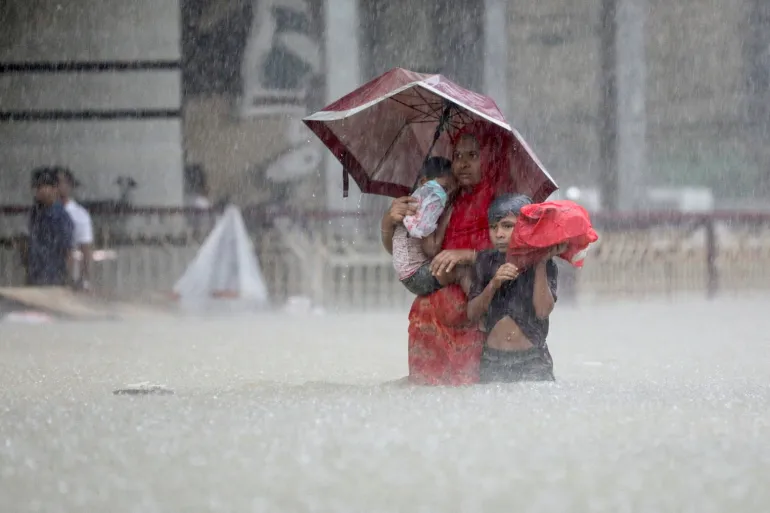
Picture Katalganj on Tuesday morning: rickshaw-pullers wading chest-deep past shuttered shops, the road gone entirely, nothing left to steer by. Picture a ten-month-old boy in Jangal Salimpur, buried under a hillside that gave way at nine in the morning, his mother pulled out injured beside him.¹
Picture a thirteen-year-old girl on Chashma Hill, killed in a landslide that took less time than it will take you to read this sentence.¹ Four hundred and fifty thousand people marooned in their own district.²
Twenty-three dead in three days, seven of them children.³ In Hamjarbagh, a resident named Zahid Islam told a reporter this happens every time it rains now, even a little — water in the road, water on his ground floor, nothing new about it at all.⁴ That’s the part that should stop you. Not the disaster. The fact that it isn’t one anymore. It’s routine.
Chattogram’s monsoon this July has been the worst in four decades, by rainfall alone.⁵ Three hundred and thirty millimetres in a single day.⁶ It would be easy, and comforting, to leave it there. Freak weather. An act of God. Nobody to blame.
It would also be a lie.
The city’s own supervising committee on waterlogging — the one reporting directly to the Chief Adviser — has already done the accounting.⁷ Chattogram’s waterbodies have fallen from 4,661 to 2,390. Its primary canals have gone from 71 to 57.⁷ Somewhere between half and seventy per cent of the ponds, lakes and low ground that once held the city’s rainwater have been filled in, built over, sold off.⁸ The Karnaphuli, into which every drop of that rain is supposed to drain, is a tidal river. At high tide, it pushes back.⁹ Layer a monsoon downpour onto a rising tide and the water has nowhere left to go — not because nature is unusually cruel this year, but because we removed every place we had built for it to go.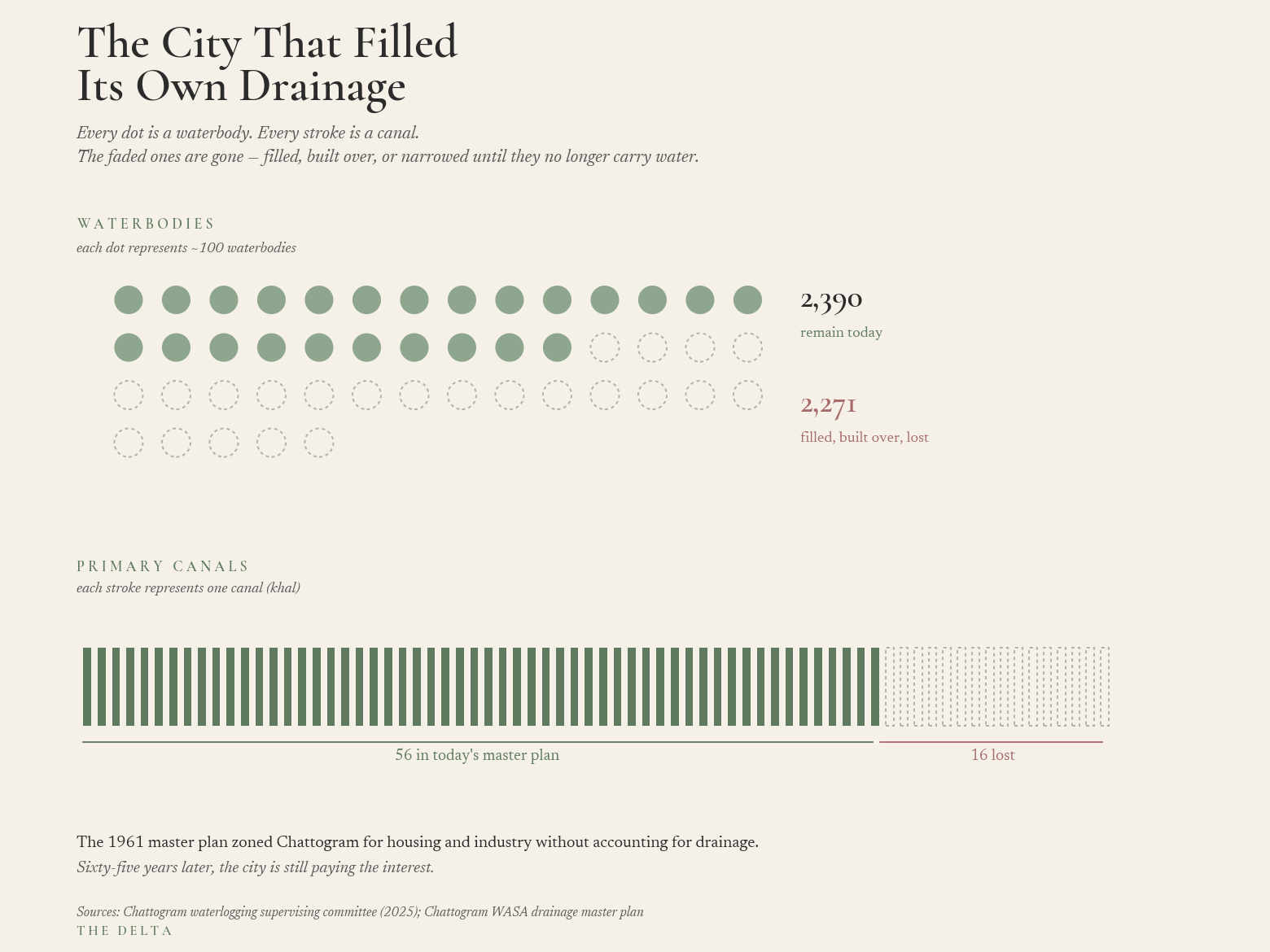
The canals that disappeared in plain sight
Start with the Chaktai Khal, the 6.9-kilometre canal that is meant to carry water from Bahaddarhat all the way to the Karnaphuli.¹⁰ In 2016, a district administration survey counted 48 illegal structures squatting on roughly 20,000 square feet of its banks — flats, tin-shed houses, warehouses, shops.¹⁰ One of them was a 793-square-foot government revenue office, built by the very city corporation charged with keeping the canal clear. It stood there for over two decades before anyone tore it down.¹⁰ Sit with that. The people whose job it was to protect the canal built on top of it, and got away with it for twenty years.
This is not an isolated case. It is the pattern. On the Hijra Khal, which carries drainage from Panchlaish and Sholashahar down to the Chaktai, building owners occupying the canal’s land have been told they will have to vacate roughly twelve feet each, land they took according to the very cadastral records the state itself keeps.¹¹ The canal is being widened from thirteen feet to twenty-six. It had shrunk to half its intended width, one illegally poured foundation at a time.¹¹
Chattogram once had 72 canals threading through it. Chattogram WASA’s own drainage master plan today lists 56.¹² The missing sixteen did not evaporate. They were filled, narrowed, built on, and forgotten, by developers who profited and by authorities who let them.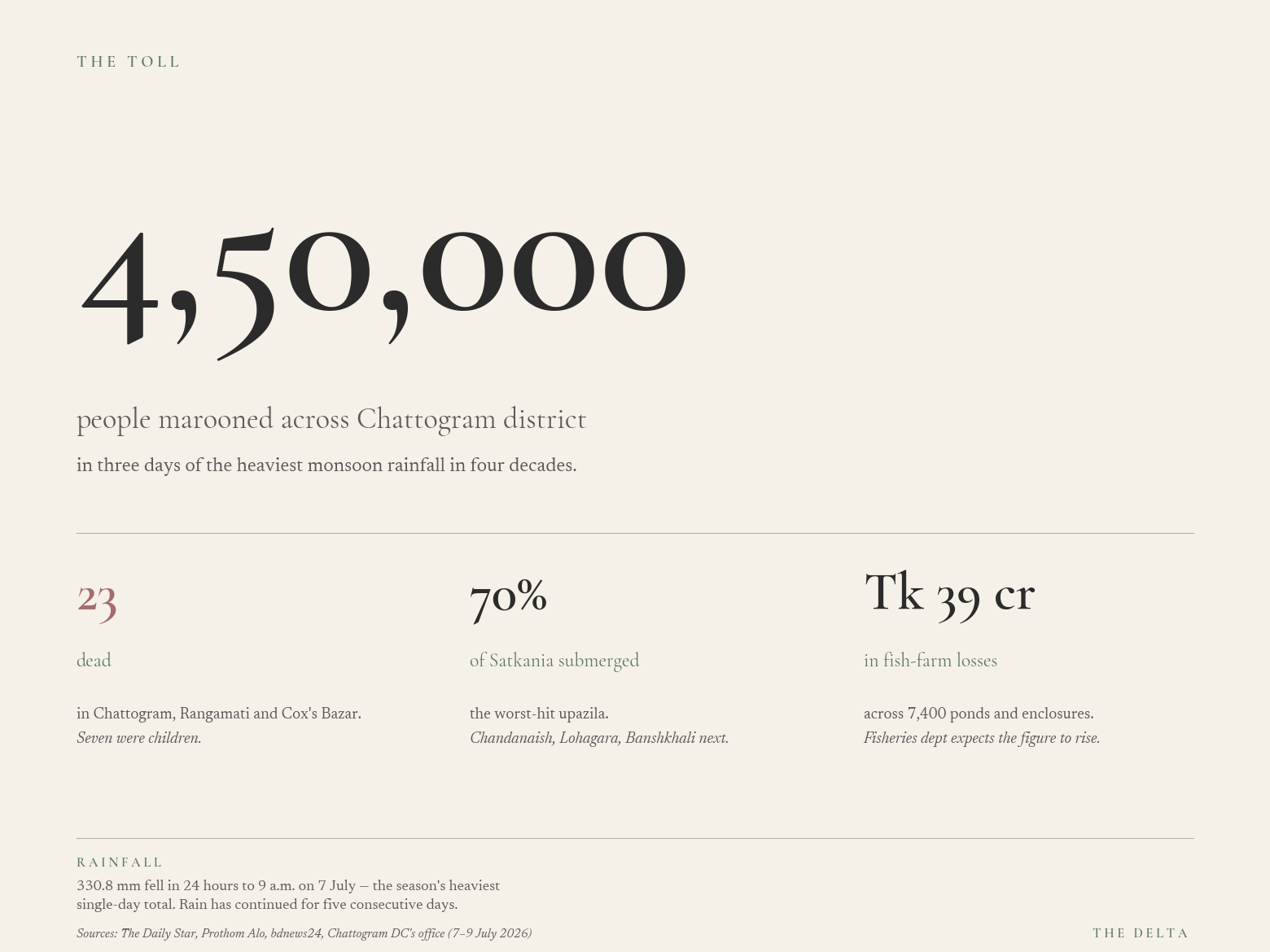
A city built without asking where the water goes
None of this happened by accident, and none of it happened quickly. Chattogram’s first master plan, drawn up in 1961, focused on zoning maps for housing and industry.¹³ It gave drainage almost no thought at all. By the time planners returned to the problem with the 1995 Chattogram Metropolitan Master Plan, the canals it was meant to protect were already disappearing under the city being built on top of them.¹³
The Chattogram Development Authority approves construction across the city. For years, it approved building on land that used to retain rainwater, low-lying plots that functioned, whether anyone designed them to or not, as the city’s overflow tanks.⁹ Meanwhile the hills ringing the city keep being cut for housing plots, and every cut hillside sends sand and loose soil straight down into the nearest canal when it rains, silting up a channel that was already too narrow to cope.¹⁴
Four separate agencies are responsible for some piece of this: the CDA for planning, the City Corporation for daily maintenance, WASA for drainage and sewerage, the Water Development Board for flood control.¹⁵ Four agencies, and by nearly every account, nowhere near four agencies’ worth of coordination between them.¹⁵ One senior adviser to the interim government, tasked with fixing the crisis, put it more bluntly than most officials dare: this waterlogging, he said, is manmade.¹⁶ Not a phrase you expect from someone inside the government. He didn’t need to soften it. Everyone already knew.
The money that keeps not being enough
It isn’t as though nothing has been spent. A CDA project launched in 2017 carries a price tag of Tk 5,617 crore.¹⁵ The Bangladesh Water Development Board, working through the army’s 34th Engineer Construction Brigade, has been excavating canals under a Tk 1,620-crore scheme running since 2019, years behind its original schedule.¹⁷ This week, as the water rose again, Chattogram’s mayor unveiled yet another plan, this one worth Tk 3,549 crore, promising to turn the recovered canals into tourist attractions once they are finally clear.¹⁸ Tourist attractions. While people were still standing in it.
Officials now project the crisis could be substantially resolved by 2027.¹⁹ Perhaps it will be. Waterlogged spots in the city have genuinely fallen, from 113 in the 2017–2023 period down to 29 this year, with floodwater draining in hours rather than days.¹⁹ That is real progress, and it deserves to be said plainly rather than buried under cynicism. But progress against a self-inflicted wound is still a long way from healing it. Every taka spent excavating a canal is a taka spent undoing a decision someone else was allowed to make for private profit, on public water, for decades, unchallenged.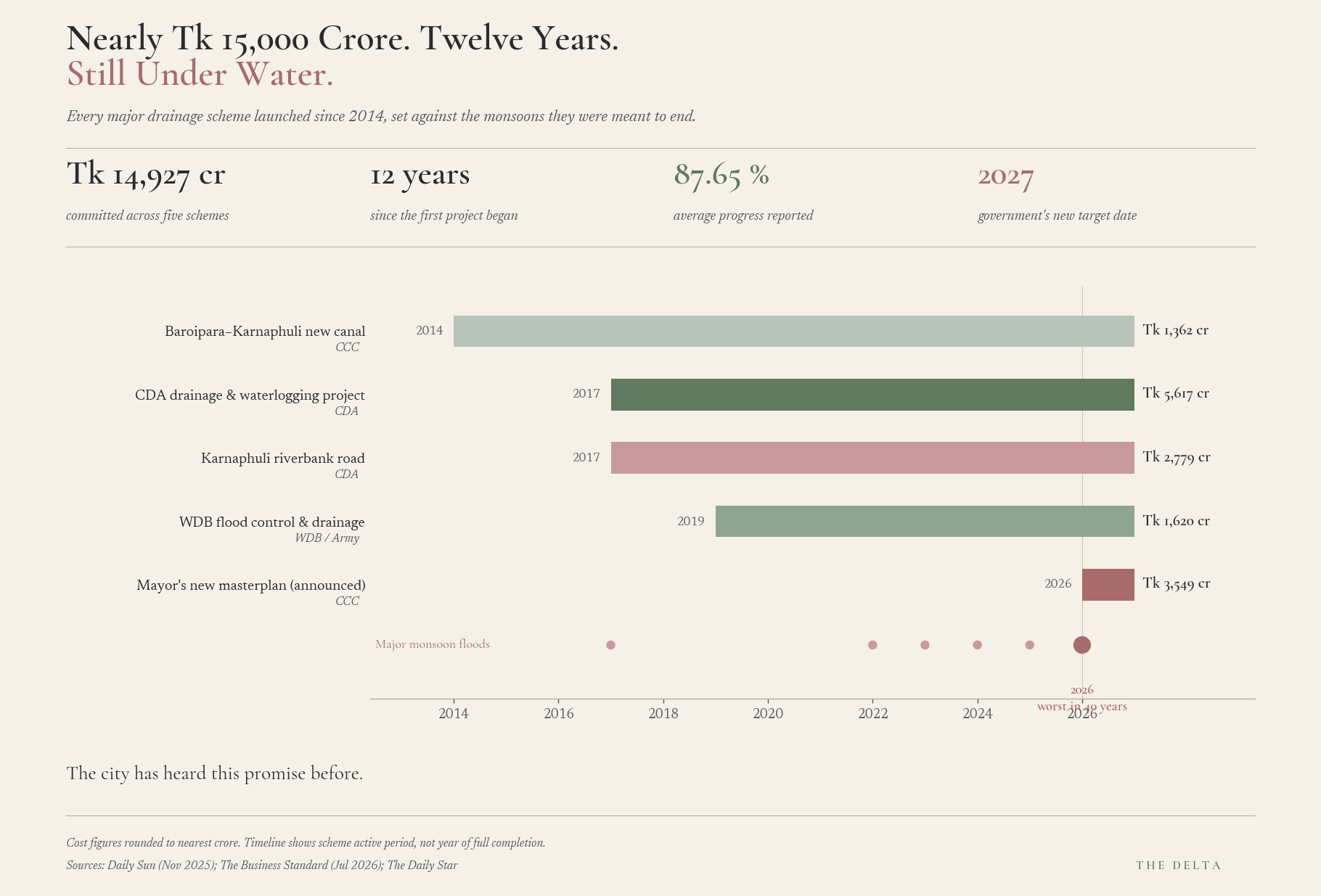
What the water actually costs
Numbers help, so here are a few more. Fish farmers alone have lost an estimated Tk 39 crore this week, across 7,400 ponds and shrimp enclosures swallowed by floodwater.⁴ Much of that stock takes a season to raise and an afternoon to lose — fry bred from Halda River carp eggs, months of feed and labour, gone the moment a pond wall gives way.⁴ Multiply that across 7,400 ponds and “waterlogging” starts to feel like too small a word for what this actually is.
Four kilometres of railway track between Chattogram and Cox’s Bazar sat under nearly two feet of water, stranding a train carrying a thousand passengers.²⁰ Half-yearly and HSC examinations were postponed across the city, twice.²¹ In low-lying wards, residents describe bailing water out of their homes only to watch it return within hours, night after night, for as long as the rain holds.²²
None of these losses show up on a masterplan’s cost-benefit sheet. They show up in a fish farmer’s ledger, a student’s delayed exam, a family’s ruined furniture, a household that will spend weeks drying out what the water reached.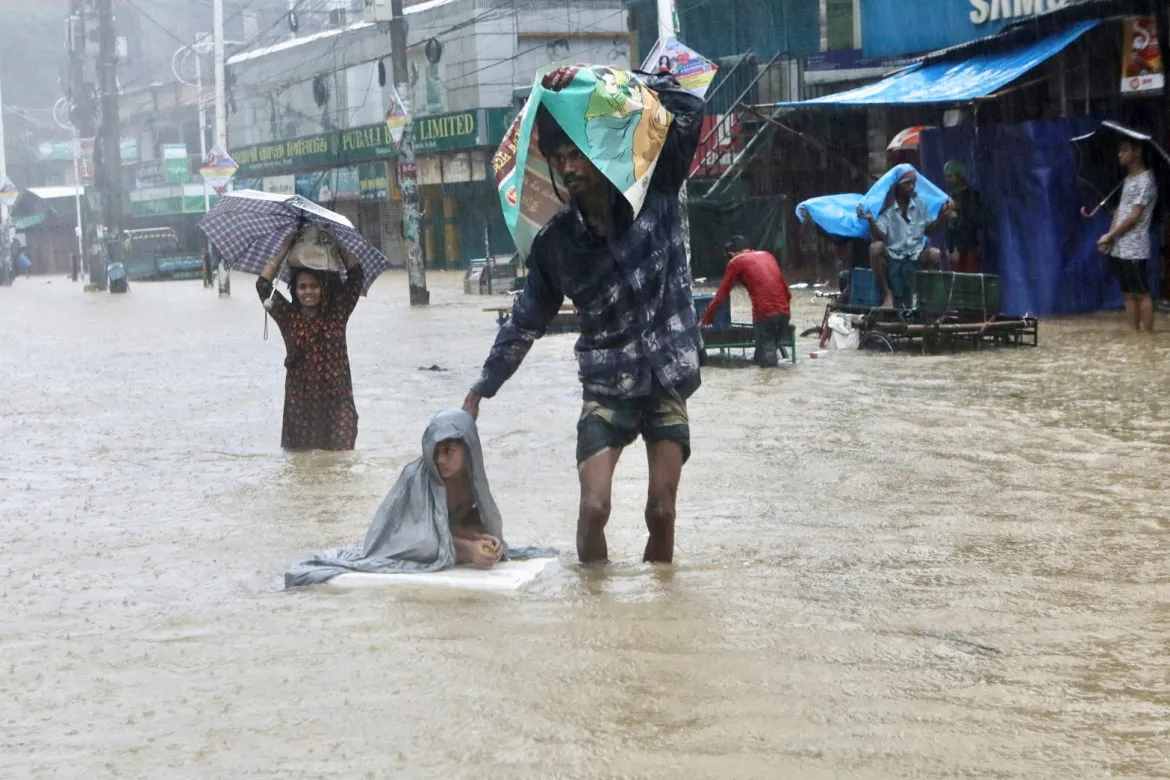
The tide will keep rising either way
There is a harder truth still to sit with. Even a perfectly executed drainage network, built exactly to specification, cannot outrun what is coming. Sea levels are rising. Rainfall is intensifying and growing less predictable.⁹ Any plan designed only around today’s tides and today’s storms will already be out of date within a generation.⁹ Chattogram is not just repairing decades of neglect. It is trying to hit a target that keeps moving, with tools that were slow even when the target stood still.
We keep calling this a flood, as though it arrived from somewhere else, as though the city were a passive victim of weather. It wasn’t. Every filled pond was filled by a permit or by a bribe. Every narrowed canal was narrowed by someone with the money to build and the confidence that no one would make them tear it down. The rain is not on trial here. We are.
The water will recede, as it always does. Reazuddin Bazar will dry out. The rickshaws will find their wheels again. And the question that will still be sitting there, once it has, is whether the people with the power to stop this will finally choose to. Chattogram has been asking that question for longer than most of its residents have been alive. It is still waiting for an answer.
References
- Prothom Alo, “Heavy rains in Chattogram: Landslides kill 22 in three days,” 9 July 2026.
- bdnews24, “Chattogram DC cancels all leaves as 450,000 marooned,” 9 July 2026.
- Prothom Alo, “Heavy rains in Chattogram: Landslides kill 22 in three days,” 9 July 2026; The Daily Star, “Chattogram reeling under monsoon fury,” 9 July 2026 (23 deaths reported).
- The Daily Star, “Chattogram floods submerge 7,400 fish farms, ponds; losses hit Tk 39 crore,” 8 July 2026.
- The Business Standard, “Heavy rain paralyses Chattogram, disrupts port, flight operations,” 7–8 July 2026.
- Prothom Alo, “Chattogram records season’s heaviest rainfall as roads collapse,” 7 July 2026.
- Daily Sun, “Chattogram set to end waterlogging by 2027,” 18 November 2025.
- The Daily Star, “Chattogram city condemned to waterlogging,” 24 September 2023.
- The Daily Star, “Chattogram’s waterlogging is a planning failure” (opinion, Masudur Rashied, urban planner and water management researcher).
- The Daily Star, “A move to mitigate waterlogging in Ctg,” 16 May 2025.
- The Daily Star, “Katalganj, Panchlaish: Excavation of canal triggers waterlogging.”
- The Daily Star, “Chattogram city condemned to waterlogging,” 24 September 2023.
- The Daily Star, “The ‘sorrow of Chittagong City’” (opinion).
- The Daily Star, “Chattogram city condemned to waterlogging,” 24 September 2023.
- The Daily Star, “Develop Chattogram’s drainage system before more lives are lost.”
- Prothom Alo, op-ed by Adilur Rahman Khan, 27 January 2025.
- The Daily Star, “Chattogram city condemned to waterlogging,” 24 September 2023.
- The Business Standard, “Heavy rain paralyses Chattogram, disrupts port, flight operations,” 7–8 July 2026.
- Daily Sun, “Chattogram set to end waterlogging by 2027,” 18 November 2025.
- Prothom Alo, “Heavy rains in Chattogram: Landslides kill 22 in three days,” 9 July 2026.
- Dhaka Tribune, “HSC, equivalent exams under Chittagong Board postponed due to floods.”
- Prothom Alo, “Heavy rains in Chattogram: Landslides kill 22 in three days,” 9 July 2026.