The Earthquake Won't Kill You. Dhaka Will.
The ground has warned us twice in seven months. We have sixty rescuers, twenty-three million people, and a city built mostly without permission. Here is what a big one would actually do — and why almost none of it is the earthquake's fault.
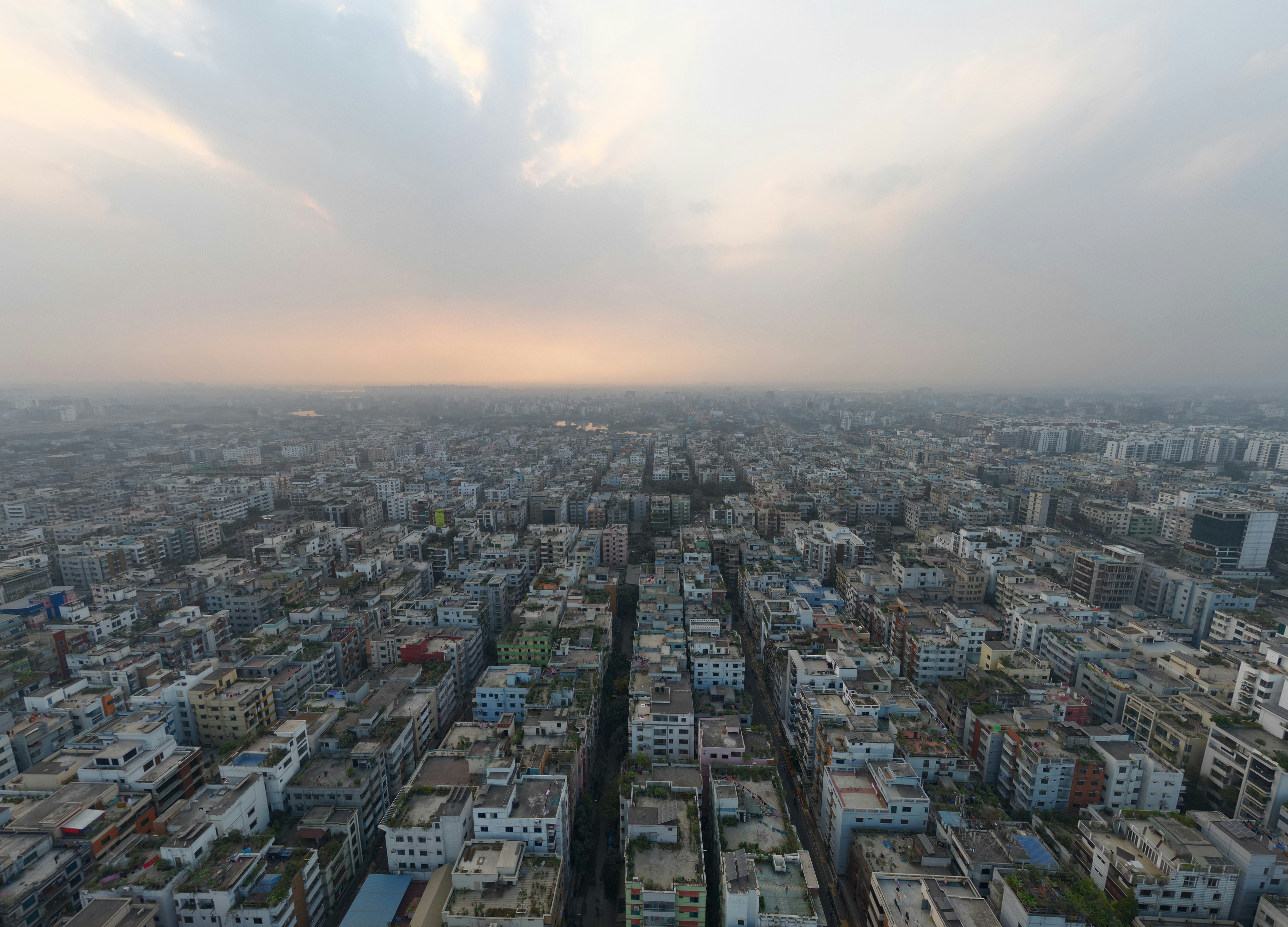
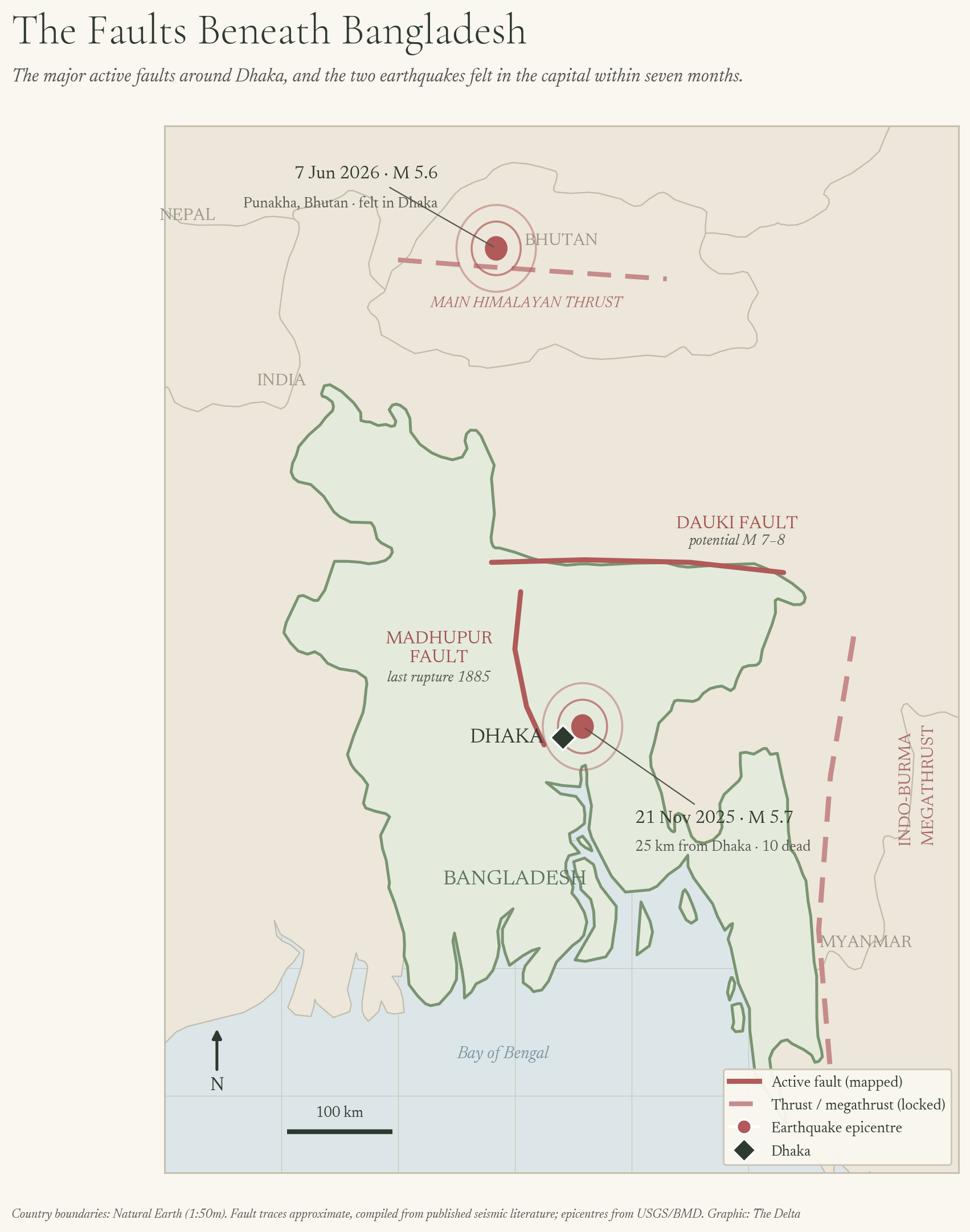
On the night of 7 June, Dhaka shook again. A magnitude 5.6, centred in Punakha, Bhutan, 432 kilometres from the Meteorological Department’s office in Agargaon.¹ Slow rolling tremors, enough to wake people up, enough to send some out onto balconies in the dark. Nobody in Bangladesh died.
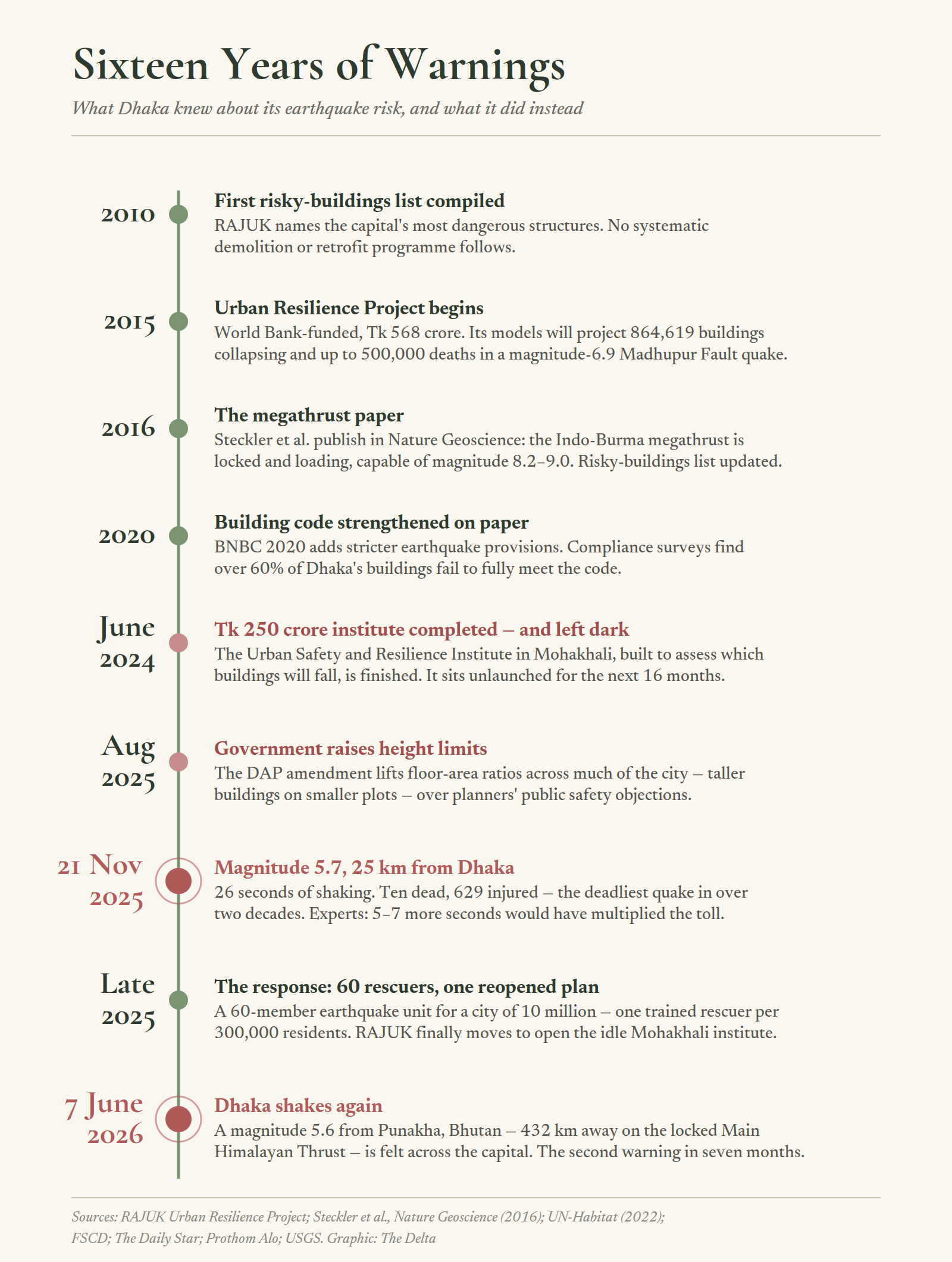
Seven months earlier, we were not so lucky. On 21 November 2025, a 5.7 struck Narsingdi, twenty-five kilometres from the city centre.² Twenty-six seconds of shaking. Buildings on Rampura TV Road fell onto each other. Ten people died, more than six hundred were hurt, and seismologists said afterwards that five to seven more seconds would have changed everything.²
Two earthquakes in seven months. Both felt across the capital. Both from the fault systems sitting directly beneath and around us. The temptation is to feel lucky, to read “nobody died in June” as good news and move on.
Resist it. Because the next part is the part nobody wants to say out loud: when the big one comes — and it is coming, the only question is when — the earthquake will not be what kills most of the people who die. The buildings will.
Three Plates, One City
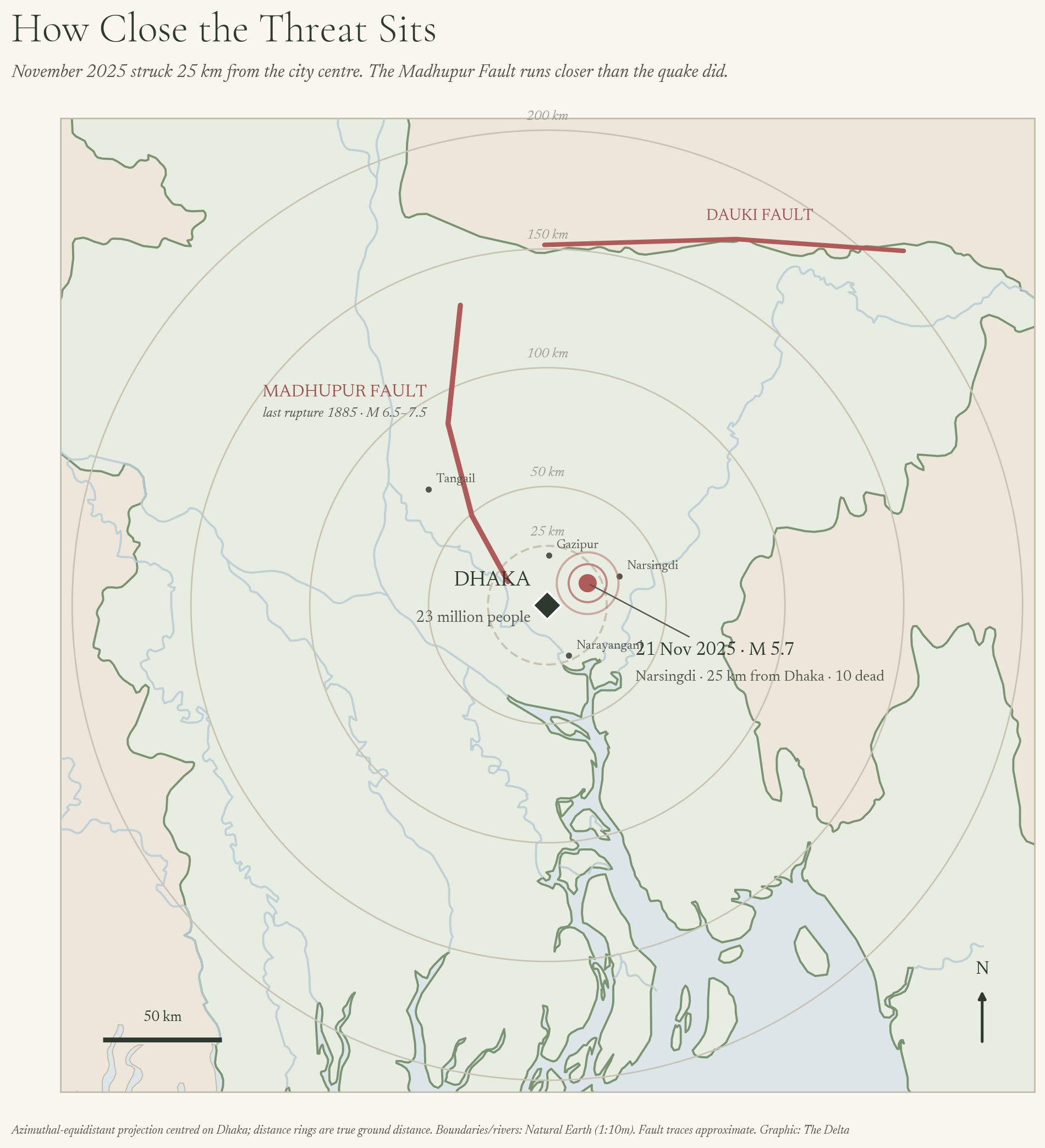
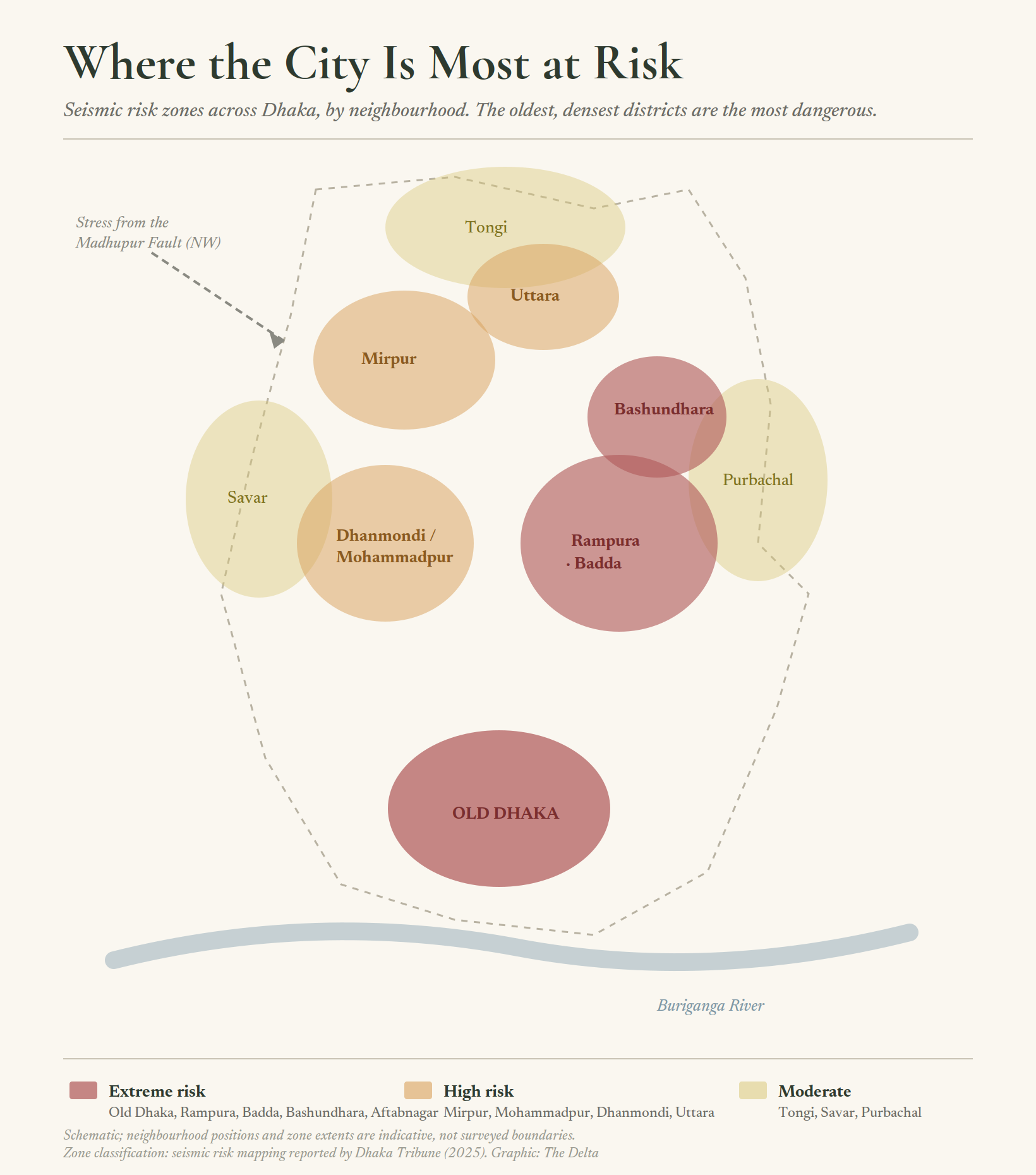
We sit where three tectonic plates collide. The Madhupur Fault, a blind thrust running northwest of the city, last ruptured in a major way in 1885 — nearly a century and a half of pressure with nowhere to go.³ The Dauki Fault in the Sylhet foothills can manage a magnitude 7 to 8.⁴ And to the east, along the Myanmar border, sits what Columbia University seismologists in 2016 called an underappreciated hazard: the Indo-Burma megathrust, locked and loading at 13 to 17 millimetres a year, with models putting its ceiling above magnitude 8.5.⁵
I want to be fair about the science, because this is where credibility is won or lost. Not everyone accepts that ceiling. A 2023 analysis of more than six thousand regional earthquakes argued that an event above magnitude 7.5 is unlikely here, given the crust we sit on.⁶ Worth saying plainly. But it changes nothing about what we must do — because the Madhupur Fault does not need to reach magnitude 8 to bury this city. It only needs to reach 6.9.
A 6.3 Killed 2,445 People
Start with Afghanistan, because it should frighten you most.
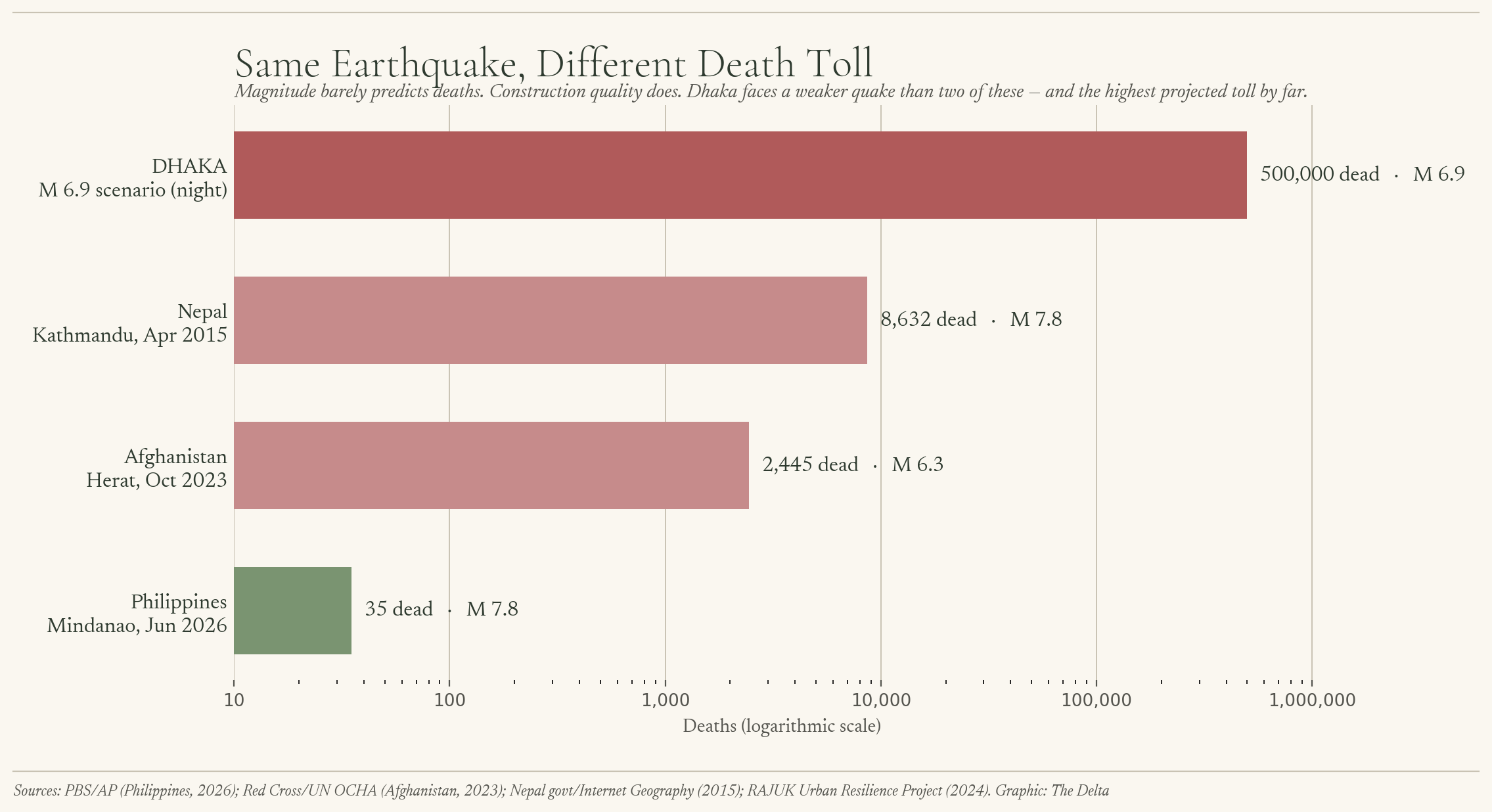
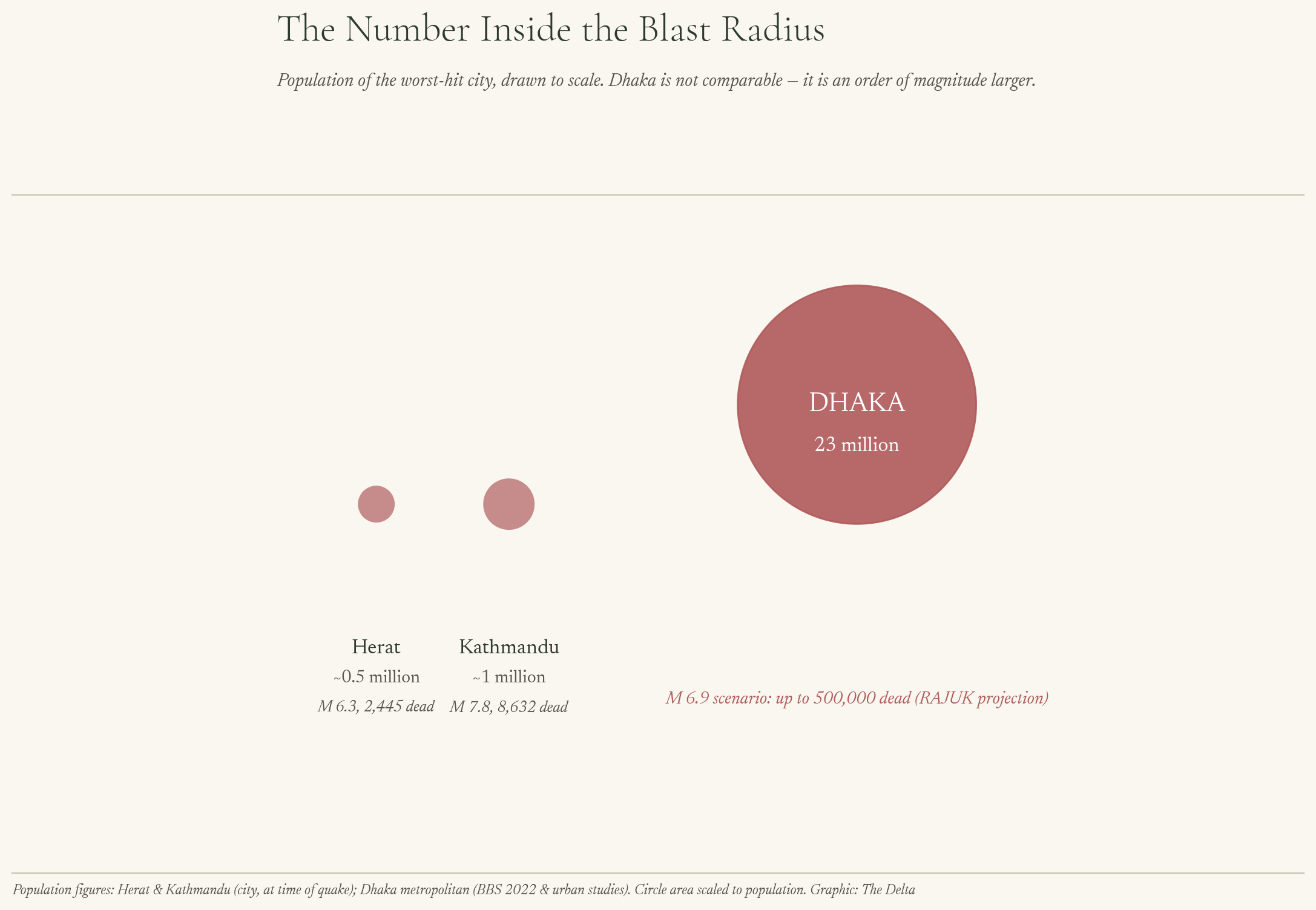
On 7 October 2023, a magnitude 6.3 hit forty kilometres from Herat, a city of half a million.⁷ Less than a minute of shaking. By the time anyone reached the outer villages, 2,445 people were dead and nine thousand injured, pulled from mud-brick homes no engineer had ever signed off on.⁷
A 6.3. Hold onto that number.
Because the quake our own government modelled for Dhaka is a 6.9 — stronger — and Dhaka has twenty times Herat’s population. RAJUK’s nine-year, Tk 568 crore survey, World Bank-funded, put it in black and white: 864,619 buildings collapse, forty per cent of the city, twenty-five billion dollars gone.⁸ The death toll runs from 210,000 in the morning to half a million at night, when we are all home, asleep, inside the very buildings that fall.⁸
We have had that report for two years. We have done almost nothing with it.
The Buildings We Built to Fall
Now Nepal, because Nepal shows you the why.
April 2015. A 7.8 strikes eighty kilometres from Kathmandu, a city of a million. More than 600,000 buildings destroyed, 8,632 dead.⁹ When American engineers picked through the rubble, they did not blame the earthquake. They blamed enforcement. Improving accountability and construction quality, they wrote, mattered more than improving the building code itself.¹⁰
Now look around Dhaka.
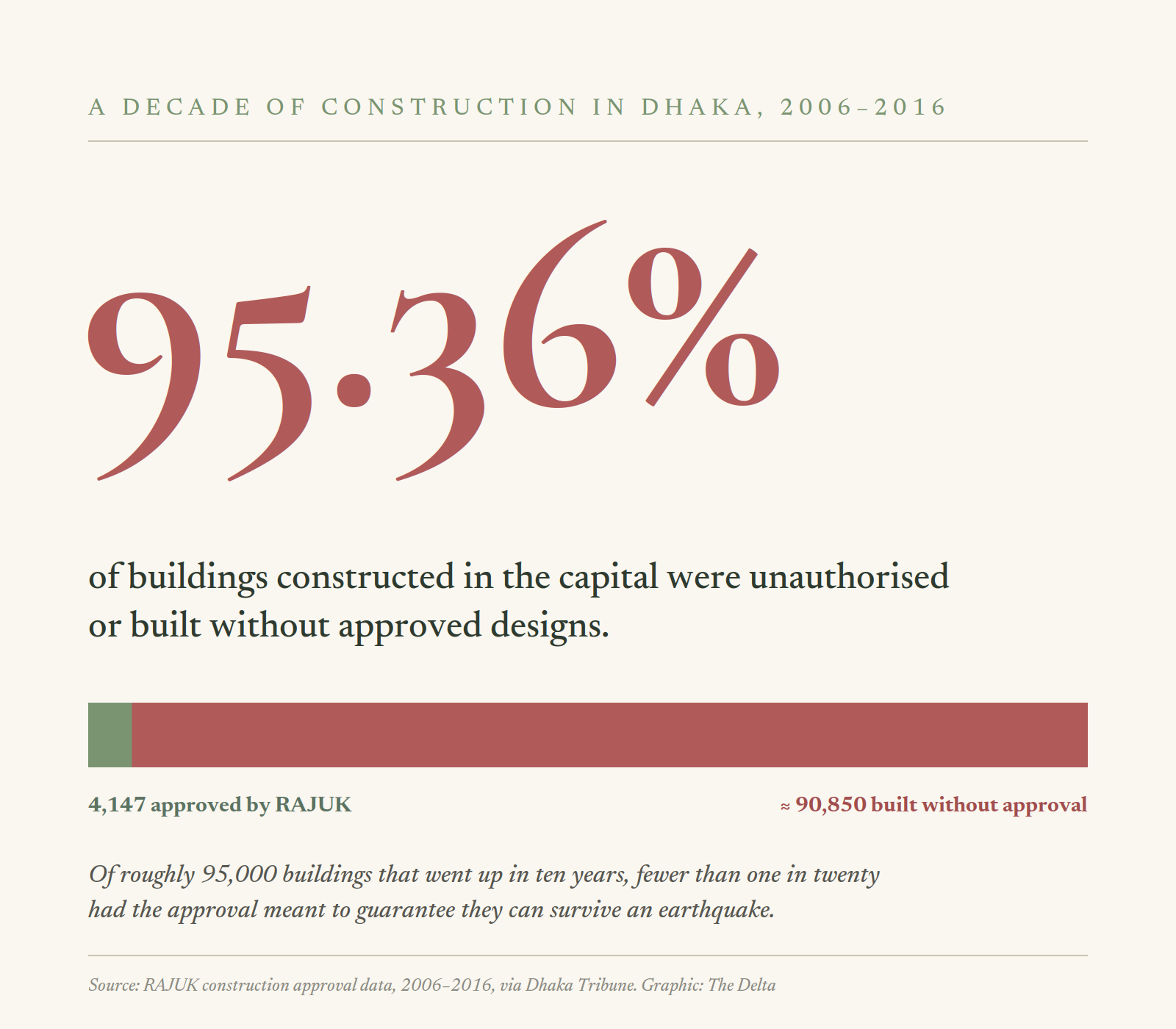
Between 2006 and 2016, roughly 95,000 buildings went up here. Exactly 4,147 had RAJUK approval.¹¹ That is 95.36 per cent — nineteen of every twenty — built with no approved structural design. No one checked the columns. No one checked the rebar. No one checked the soil. Professor Mehedi Ahmed Ansary of BUET, who has actually modelled how these buildings behave, said it after November’s quake: “This kind of damage is inevitable.”¹² He meant it even at magnitude 5.5 to 6.0 — the range we have already lived through, twice.¹²
Inevitable. That is a structural engineer’s word, not a journalist’s.
And here is the absurd part. Until 2025, structural sign-off was not even required before construction began. You needed a drawing of what the building would look like. You did not need the engineering that decides whether it stays standing.¹¹ We regulated the façade and left the skeleton to luck. Only 40 per cent of new buildings met even the 2012 code; UN-Habitat put non-compliance above 60 per cent.¹³
There are 321 buildings in this city officially marked extremely risky. The first list naming them was drawn up in 2010.¹⁴ Sixteen years later, they are still standing — still full of people who do not know they are on it, because the colour-coded risk map exists and the government has never released it. A senior official at the disaster ministry admitted it in November: “The list was never published.”¹⁵
We did the survey. We filed it. We let people keep living in the red.
Thirty-Five Dead. From a 7.8.
Then the Philippines, because the Philippines proves it does not have to end this way.
On 8 June this year — the day after Dhaka felt the tremor from Bhutan — a 7.8 struck off Mindanao.¹⁶ Same magnitude as Nepal. Some low-rises came down, a landslide killed thirteen, and the total dead came to thirty-five.¹⁶
Thirty-five. From a 7.8.
The difference was not the earth. It was a building code that gets enforced, and rescue crews who showed up with equipment that worked. That is the entire distance between thirty-five funerals and eight thousand.
So which one will Dhaka be? Ask the rescuers.
Sixty People
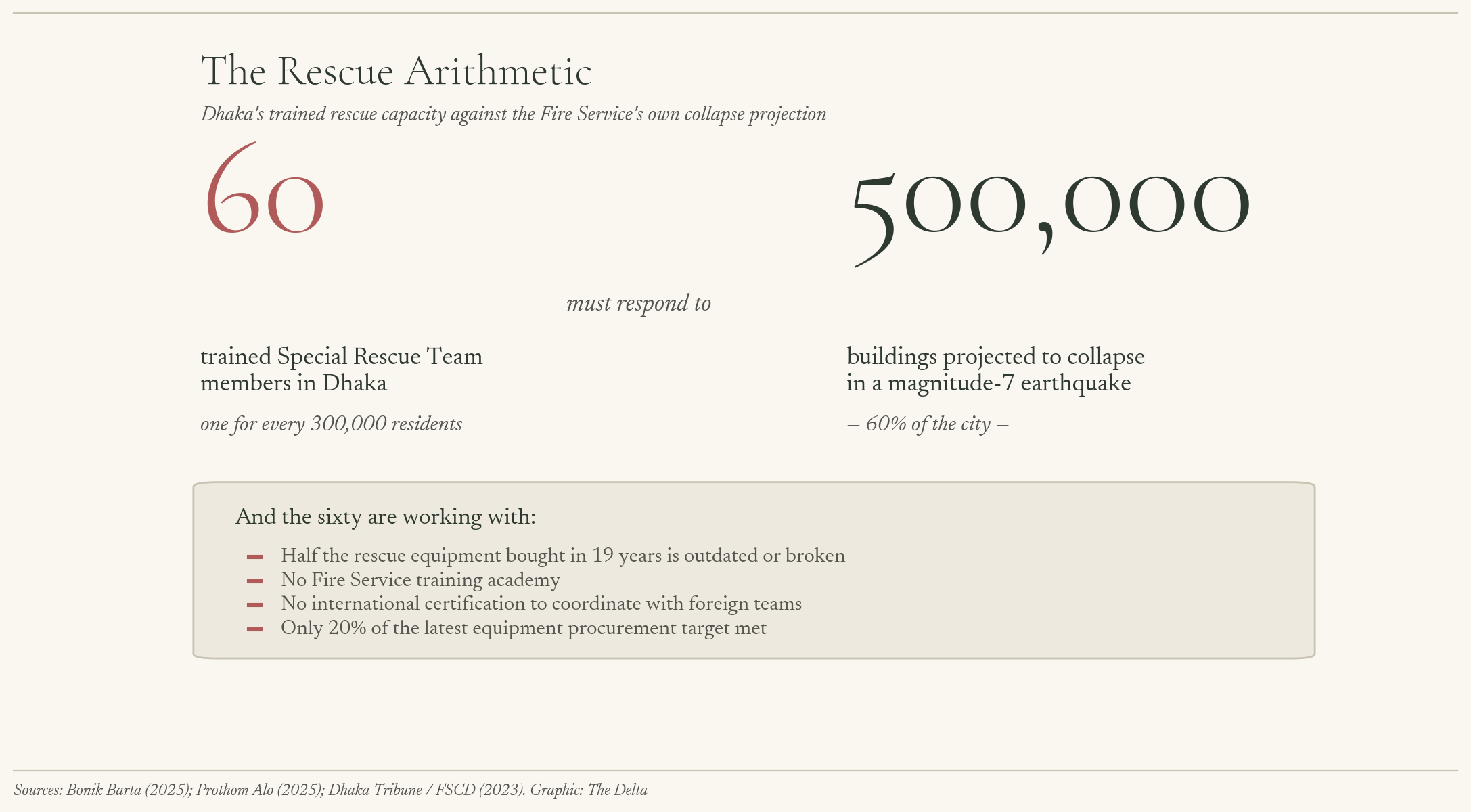
Dhaka has sixty members of the Fire Service’s Special Rescue Team. Sixty.¹⁷ One trained rescuer for every 300,000 people. The Fire Service’s own officers say a magnitude-7 quake would flatten around 500,000 buildings here.¹⁸ Half their specialist equipment, bought over nineteen years, is already broken or obsolete.¹⁹ There is no training academy. None of them hold the international certification needed to work beside the foreign teams who would fly in.¹⁹
A dedicated sixty-member earthquake unit was announced in May 2025. It is real, and I will not pretend it is nothing.²⁰ But against half a million collapsed buildings it is not a plan. It is the look of preparation without the fact of it.
Picture the night it happens. Half a million buildings down. Sixty people with half their gear working, trying to reach the trapped through lanes in Old Dhaka so narrow that a single fallen wall seals them off. In Nepal, teams from forty-five countries still could not get everyone out — and Kathmandu had a million people across open mountain valleys. We have twenty-three million in a delta basin, on soil that turns to liquid when the shaking runs long enough.
The bodies would be under the rubble for days. In places, weeks.
Twenty-Three Million on Liquid Ground
That number — twenty-three million — should keep every planner in this country awake.
Dhaka was built to hold about twelve million.²¹ It holds nearly double, at 49,000 people per square kilometre, one of the densest cities on earth.²¹ The lanes of Old Dhaka, extreme-risk in every survey ever done, are too tight for the machines that lift concrete off a person. There is almost no open ground to flee to.
And here is what the same government, holding every page of this data, chose to do in August 2025 — months before the ground moved twice. It raised the height limits. It let developers build taller on smaller plots, over the loud objections of the city’s own planners.²² The state’s answer to living on a locked fault was to let us stack ourselves higher on it.
The Building in Mohakhali
There is a building in Mohakhali I cannot stop thinking about.
We built an entire institute to assess which of our buildings will fall — Tk 150 crore for the structure, another Tk 100 crore for laboratory equipment shipped in from Britain and Europe. Finished in June 2024.²³ Then it sat. Locked. Dark. For sixteen months, while the city kept rising around it, untested. RAJUK moved to open it only after November’s quake made the silence embarrassing.²³
We bought the smoke alarm, mounted it on the wall, and never connected the battery. Then we waited to smell smoke.
The Fault Does Not Check the Calendar
I am not telling you the sky is falling. I am telling you we built a ceiling that will.
Professor Syed Humayun Akhter, who has spent his career mapping these faults, said after November: “We are fortunate the quake was not magnitude 7 or 7.5.”²⁴ He is right. We were lucky. But luck is not a plan, and luck does not refill. The Madhupur Fault last broke in 1885; the record says this region produces a magnitude-7 roughly every 150 years.²⁵ We are 141 years in, and the fault does not check the calendar.
When it goes, the number of dead will not be written by the earth. It was written years ago — in approval offices that stamped nothing, in the filing cabinet where the risk map still sits, in the construction sites that never saw a structural engineer, in a procurement budget where most of the rescue equipment was simply never bought.¹⁹ Afghanistan shows what a moderate quake does to a place that cannot respond. Nepal shows what a strong one does to bad buildings. The Philippines shows that the whole catastrophe is optional.
We have been warned twice in seven months. The earth has been almost polite about it.
It will not stay polite. And when it stops, the thing that decides whether you live will not be the magnitude on the news ticker. It will be who built your building, and whether anyone ever made them do it right.
So far, the answer is no one. That has to change before the ground changes it for us.
References
[1] “5.6 Magnitude Quake in Bhutan Shakes Dhaka, Parts of Bangladesh,” The Business Standard, 7 June 2026; Bangladesh Meteorological Department; USGS.
[2] “2025 Bangladesh Earthquake,” USGS-ANSS; “Dhaka’s Housing at Risk as 5.7 Quake Exposes Glaring Vulnerabilities,” Dhaka Tribune, 22 November 2025; The Business Standard, November 2025.
[3] Madhupur Fault 1885 rupture: Dhaka Tribune, 22 November 2025.
[4] Dauki Fault potential: The Daily Campus, November 2025; seismic literature.
**[5]** Steckler, M.S. et al., “Locked and Loading Megathrust Linked to Active Subduction Beneath the Indo-Burman Ranges,” Nature Geoscience, 9, 615–618 (2016). https://doi.org/10.1038/ngeo2760
[6] Analysis of 6,412 earthquakes (1900–2023); Geological Survey of Bangladesh / Academia.edu (2023).
**[7]** Red Cross UK, 16 October 2023. https://www.redcross.org.uk/stories/disasters-and-emergencies/world/afghanistan-earthquake-2023; CNN, 8 October 2023; UN OCHA, October 2023.
**[8]** RAJUK / World Bank, Urban Resilience Project (2015–2024); “RAJUK Itself Warns 40pc of Buildings Could Collapse in a Major Earthquake,” Prothom Alo (English), 25 November 2025. https://en.prothomalo.com/bangladesh/city/v0uq2rlbx6
**[9]** Internet Geography / Nepal government figures. https://www.internetgeography.net/geotopics/nepal-earthquake-2015
[10] “Enforcement More Important Than Improving Building Code,” The Kathmandu Post, 25 July 2015; Build Change, Nepal Earthquake Reconnaissance Report, October 2015.
[11] Dhaka Tribune, 22 November 2025; Observer BD, 22 November 2025.
**[12]** Prof Mehedi Ahmed Ansary, BUET; Bonik Barta (English), 23 November 2025. https://en.bonikbarta.com/bangladesh/N0xt9S4AEnGyOOcp
[13] Ministry of Housing and Public Works compliance survey (2019); UN-Habitat, Bangladesh Urban Assessment (2022).
**[14]** The Business Standard, 24 November 2025. https://www.tbsnews.net/bangladesh/earthquake-damages-300-buildings-dhaka-rajuk-inaction-irks-hc-1293076
[15] KM Abdul Wadud, Additional Secretary, Ministry of Disaster Management; Bonik Barta (English), 23 November 2025.
**[16]** Philippine Daily Inquirer, 9 June 2026. https://newsinfo.inquirer.net/2242307; PBS NewsHour / AP, 9 June 2026.
[17] Bonik Barta (English), 23 November 2025 [Special Rescue Team figures].
[18] Dhaka Tribune, February 2023 [500,000-building projection from FSCD officers].
[19] Prothom Alo (English), 23 November 2025; Brig. Gen. (Retd) Ali Ahmad Khan, former FSCD Director General, Prothom Alo, November 2025.
[20] Bangladesh Fire Service and Civil Defence announcements, May 2025.
[21] UN World Urbanization Prospects; Bangladesh Bureau of Statistics (2022).
**[22]** The Daily Star, 17 December 2025. https://www.thedailystar.net/opinion/views/news/rajuks-short-sighted-dap-puts-millions-risk-major-quake-4060091
[23] Prothom Alo (English), 25 November 2025 [USRI: Tk 150 crore building, Tk 100 crore equipment, 16-month idle period].
[24] Dr Syed Humayun Akhter, Dhaka Tribune, 22 November 2025.
[25] Prof Mehedi Ahmed Ansary, BUET, via bdnews24, April 2025; Steckler et al., Nature Geoscience (2016).